- The Dodo Club Newsletter
- Posts
- The Dodo Club (60th Edition)- Ghost Ideas, Ghost Stories, and Ghost Scenarios
The Dodo Club (60th Edition)- Ghost Ideas, Ghost Stories, and Ghost Scenarios
The future doesn’t exist yet. But stories of the future are always at play in our minds, shaping our choices and hence shaping the future.

Jeremy Bentham
February 05, 2026
A note from me:
Hi Folks,
I hope your passage into 2026 continues to go as well as you expected, or even better.
I had a somewhat unexpected pleasure this past week as I was able to meet with a former member of my former team, Syarnissa Dahuri or “Nissa” as she is known to me.
Nissa is based in her home country of Malaysia but was in Amsterdam for a meeting with her colleagues in the Shell International Technology team. She is one of the most inspirational and resilient people I know. She was born into difficult mixed-race family circumstances in Malaysia with what she refers to as her three superpowers. She was born almost completely blind, with spina bifida, and damaged lungs. In addressing all of these challenges, she has become strong and attentive and generous well beyond what anybody would normally imagine. Despite huge challenges in sight and mobility, and social rejection by the many people repelled by visible disability, she studied diligently – absorbing lessons through hearing alone - won two Fulbright scholarships and went to university in Australia, and secured a job through which she now financially support others in her family.
She is a wonderful, authentic communicator – I first encountered her via a video before inviting her into my extended team. I believe that one reason she is such a good communicator is that she has learned to listen very attentively to what others are saying and to sense their positions or needs. I’d like to share more aspects of her incredible story that I am aware of, but will not do this without her full permission. Eventually, however, I would like to encourage somebody to write her full story or make a film about her so that others can be encouraged when they are facing seemingly insurmountable challenges. Life is still very hard for Nissa – both medically and socially – but she continues to push onwards with a positive attitude, withstanding the challenges to her mental health as well as physical health. Here are links to an interview she gave some time ago and also her LinkedIn connection.
Nissa could have absorbed many negative, indeed frightening, stories about physical disabilities but instead of becoming trapped by these unhelpful “ghost stories” she has developed and shared her own positive narratives about superpowers. In this current series of Newsletters, I am attempting to address more of our unhelpful “ghost stories”.
The notion of frightening and malevolent spectral beings influencing our conscious or subconscious lives has occasionally been explored in the visual arts. A renowned example is the following painting, “The Nightmare” by Henry Fuseli, created in 1781.
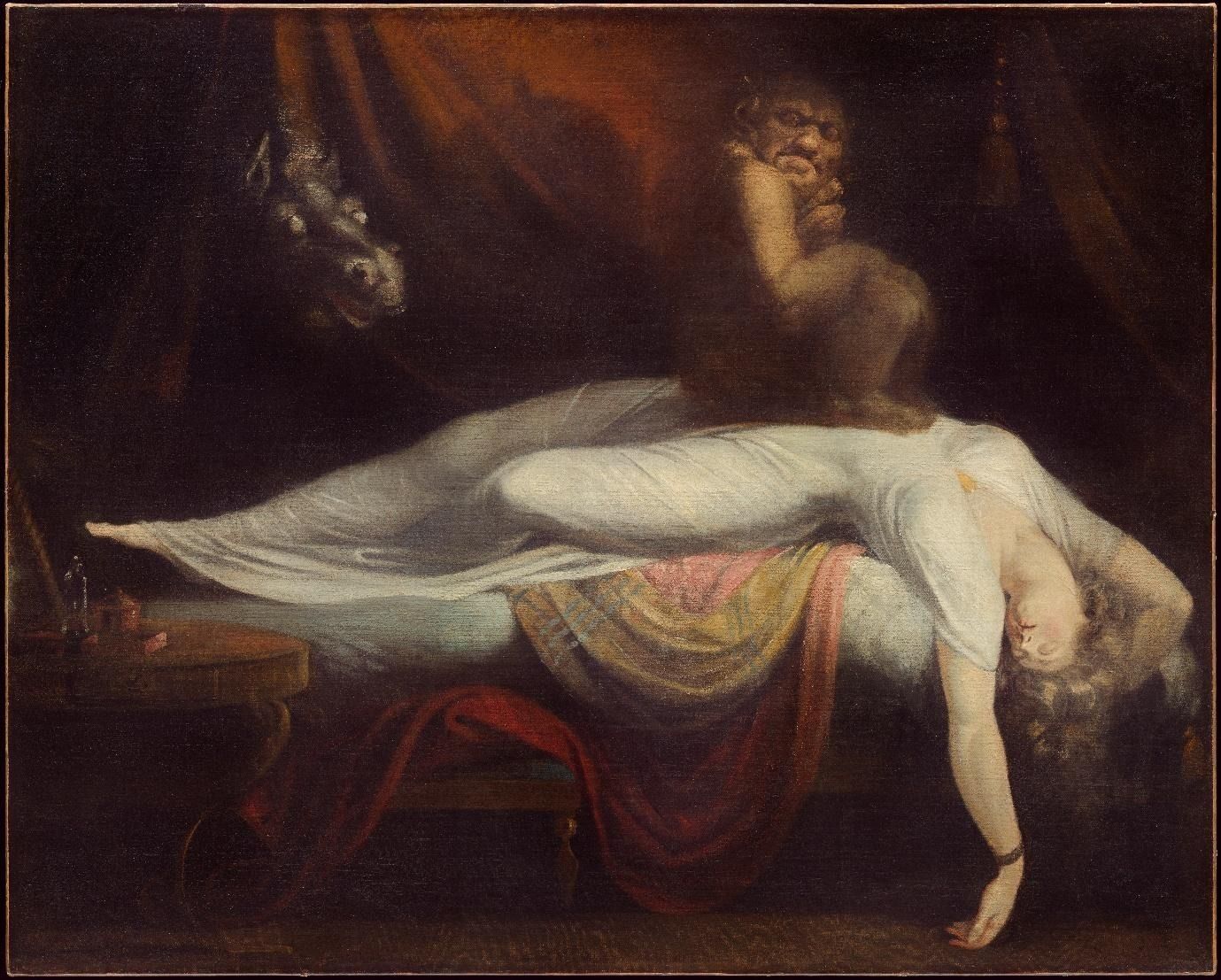
This original version of the painting can now be found at the Detroit Institute of Arts. It probably influenced Mary Shelley in a scene from her 1818 Gothic novel “Frankenstein”. Shelley’s parents knew Fuseli and the imagery describing the Creature's murder of the protagonist Victor's wife seems to draw from this canvas,
My Bi-weekly Guide:
Ghost Ideas, Ghost Stories, and Ghost Scenarios
In the last Newsletter, we considered what I referred to as “ghost stories” – misleading narratives deep in our minds that shape our behaviours in unhelpful ways. These can give rise to “ghost scenarios” in our minds about the way our future may evolve, which affect the choices we make in the present. We may not even recognise the existence of such stories in our minds but they are always at play. Only if we make them explicit and examine them, share them with others, and refine them, can improved scenarios become better guides for our collective choices.
This is the backdrop for understanding why scenario thinking and development can be fundamental to wiser decision-making. I am thankful to Betty Sue Flowers for originally introducing me to the notion of “ghost scenarios” many years ago, and highly recommend her new book Scenarios: Crafting and Using Stories of the Future to Change the Present.
In that previous Newsletter, we looked at a notion about Energy Transitions that seems deeply rooted in the minds of most people. I drew on my deeper experience and understanding of the energy system to highlight misleading aspects of this common story and outlined an alternative that could be a better guide. I referred to this as “purging ghosts”.
Since writing that Newsletter, a few people have asked me what I really mean when I speak of “ghost stories”. Do I mean that such accounts are always untrue, based on a belief that there are no such things as ghosts? Or do I mean accounts that seem to “haunt” us, or mislead us, or oppress us? Or am I referring to things that are hidden from our awareness, beyond our capacity to recognise but nevertheless having potentially malevolent influence?
This is a good challenge for me. Somehow, the notion of “ghost” wraps together all these possibilities. That can be the power of words and the power of art, communicating something significant to people at a subconscious level that has, however, to be made explicit in some way in order to be communicated. This interplay of conscious, analytical thinking and subconscious, empathetic awareness is well explored in Iain McGilchrist’s book The Master and His Emissary.
Trying to make more explicit my own meaning of “ghosts” in the contexts I am using the word is likely to be helpful, even if it is the deeper resonances of this word that are likely to be most powerful. As I think about it, I recognise that I leave open in my mind the possibility of a spiritual dimension to reality that we are only occasionally aware of – so my baseline is not “there are no such things as ghosts”.
I guess that the common thread in my mind is “lacking in substance”.
“Ghost scenarios” are fragments of stories about possible futures that exist only in individual minds and are often internally inconsistent. “Ghost stories” are partial accounts of current or past circumstances that lack evidence or context. “Ghost ideas” are background thoughts held without sufficient scrutiny or evidence, which may arise from ghost stories and yet influence our way of interpreting the world around us.
As an example, ghost ideas still persist with some people about innate biological and cognitive differences between races, which build on racist historical ghost stories that abused evolutionary biology and Darwinian theory to justify slavery, colonialism, eugenics and apartheid. These notions still feed ghost scenarios in the minds of some people about future strife, fuelled by racial differences more than social frictions and political choices.
As another current example, the future impact of the recent rise of the Chinese economy has been interpreted by some through the ghostly lens of the ancient Greek historian Thucydides, who observed that “It was the rise of Athens and the fear this inspired in Sparta that made war inevitable”. The supposed inevitability of war between established and rising powers has led to a ghost scenario in the minds of many of an inevitable future war between China and the United States. This ignores, of course, the many plausible alternative ways that relationships between these states could evolve if wise choices are taken by all parties. These would be different kinds of stories - better stories with fewer ghosts from the past.
In coming Newsletters, I’ll reflect on interpretations of various current affairs and explore what appears to be ghostly about these and what appears substantive. I’ll also consider how ghost stories may not always be misleading but can also occasionally reveal important truths to us, as the ghosts of Christmas Past, Present and Future did to Ebenezer Scrooge in Dickens’ "A Christmas Carol".
What I would already advise everybody, however, is to make yourself aware of the ideas, stories and scenarios in your mind that are shaping your own behaviour and choices, and to open these up to scrutiny, even if only by yourself. The scenario mindset is a valuable step towards strengthening character (see Newsletter Edition 2).
Question of The Fortnight
Every fortnight, I’ll be asking a thought-provoking question in hopes of sparking interesting and enlightening discussion.
I’d love to hear your response! You can do so by simply responding to this email.
Today’s question is:
Are there particular ideas, stories or scenarios in your mind which are shaping your behaviour and choices that you should be scrutinising more to assess whether they are ultimately misleading or helpful?
The Dodo Club Online Course
If you would like to learn more about the kinds of topics covered in these Newsletters, then please consider signing up for the introductory online course.
This covers scenario/systems thinking for grappling with uncertainty, an introduction to energy transitions, and the development of strategic character in leadership.
In the interest of avoiding the fate of that unfortunate bird, the Dodo, this course aims to help us secure our own personal legacies within a changing world and the energy transition - and to leave a healthier planet for future generations.
You can access the course through Udemy using the link below!
A series of follow-up courses that treat the main topics in increasing depth and detail will be provided if there is sufficient interest.