- The Dodo Club Newsletter
- Posts
- The Dodo Club (63rd Edition)- Middle East Prospects
The Dodo Club (63rd Edition)- Middle East Prospects
Great wisdom, statesmanship, diplomacy, and socio-political maturity will be required from multiple parties to avoid the very worst scenarios.

Jeremy Bentham
March 25, 2026
A note from me:
Hi Folks,
I write this after the type of good weekend you need following an emotionally difficult period. As mentioned in the last Newsletter, my mum passed away recently, and we are still dealing with the emotional and practical aftermath, but life goes on for the rest of us and good things can still take place.
Weeks ago, my elder grandson and I had already planned to meet up this weekend to watch our beloved football team, Everton, take on the might of wealthy Chelsea. We had lunch together beforehand with plenty of good conversation ranging from the current state of the world through to his studies of physics and his activities in the university drama and cinema societies. He is an exceptional young man – of course, as his grandfather, you’d expect me to say that – but it is absolutely true!!!
At the stadium there was an incredible atmosphere. This is the first season at the fabulous new ground, but it is gradually building the passion always generated previously at iconic Goodison Park.

There was a background edge to this game as the Chelsea club had just received a modest fine for financial irregularities that were far greater than the accidental contravention of ambiguous rules from Everton a couple of years ago which resulted in a huge points deduction that almost drove us to relegation. There is no consistency in punishment and one wonders about machinations within the Premier League or at least there being one rule for the rich and another for the poor.
The estimated value of the Chelsea squad is three times that of the Everton squad. A 2025 UEFA report highlighted Chelsea's squad as the costliest ever assembled in terms of transfer fees, with costs exceeding $1.73bn, so they should have the individual players to dominate Everton on the pitch.
However, of course, as with any team, it is possible for the whole to be greater than, or less than, the sum of the parts. In this case, Everton’s team cohesion, spirit and tactics far exceeded that of Chelsea – with a great debt of thanks to the work of manager David Moyes and his coaching team. The result? Three-nil to Everton and wild celebrations!
So, all in all, a wonderful weekend and a powerful reminder that teams can dramatically out-perform expectations in the right circumstances. Actually, if that topic particularly interests you, take a look at the Newsletter series on High-Performance Teams starting with Dodo Club Edition 21.
My Bi-weekly Guide:
Middle East Prospects
As noted in the last Newsletter, we are again in very troubled times with the primacy of “might is right” being violently asserted. Destruction is raining down on people across the Middle East. Many families are grieving the loss of loved ones.
What happens now? What is the outlook? It is literally impossible to tell. As an experienced scenario practitioner, I know there are so many currents and counter-currents at play, with so many influential actors weighing up different possible choices, that there are a huge number of possible scenarios. There are many permutations, ranging from the apocalyptic to the merely awful.
At worst, the regime in China could decide that the breakdown in international norms and the diversion of U.S. military attention and might to the Middle East war provides them the best opportunity in decades to invade Taiwan. That would bring war in Asia to add to wars in the Middle East and Europe. I don’t believe this is likely but it is not out of the question.
The escalation in energy prices is generating a lot of headlines at the moment. The high prices are benefitting some and damaging others, but the big winners currently are the Russian regime which now has more funds for military investment to support its war in Ukraine and to lubricate the internal wheels of patronage that keep it in power. European leaders are faced with economic disruptions at a time when increased military funding to Ukraine is required because the US regime has shifted essentially all attention and resources to the Iranian conflict. There is a great need to “step up” to oppose the aggressive expansionist aims of the Russian regime which is really aimed at solidifying its own domestic political support, otherwise more European national borders will be threatened in future. However, the socio-political will to do this is feeble in many countries as populations take the comfortable status quo for granted.
As someone with decades of experience in the energy system, I am aware that current oil prices are not exceptional when adjusted for inflation. The relative short-term inelasticity of both demand and supply curves at the margin is a recipe for high price volatility in times of disruption, but there are many economic “springs” at play over the medium term which mean that prices will not stay above 100-140 $/bbl, or dip below 30-40 $/bbl, for prolonged periods as the global economy adjusts. And it should not be forgotten that many of the everyday prices experienced by consumers are mainly the result of taxes and duties under domestic control and not the underlying international commodity price, e.g. 100 $ per barrel is about 63 cents per litre, while we are paying over $2.5 per litre for gasoline in the Netherlands. So we will experience short-term economic disruptions with distributional effects (the poorest always suffer most) but the longer-term macro-economic drag will be limited. Also, if anything, the current disruptions will increase attention to energy transitions and reducing reliance on imported oil and gas over the longer term. Watch out for how China makes further technological and policy progress in this regard.
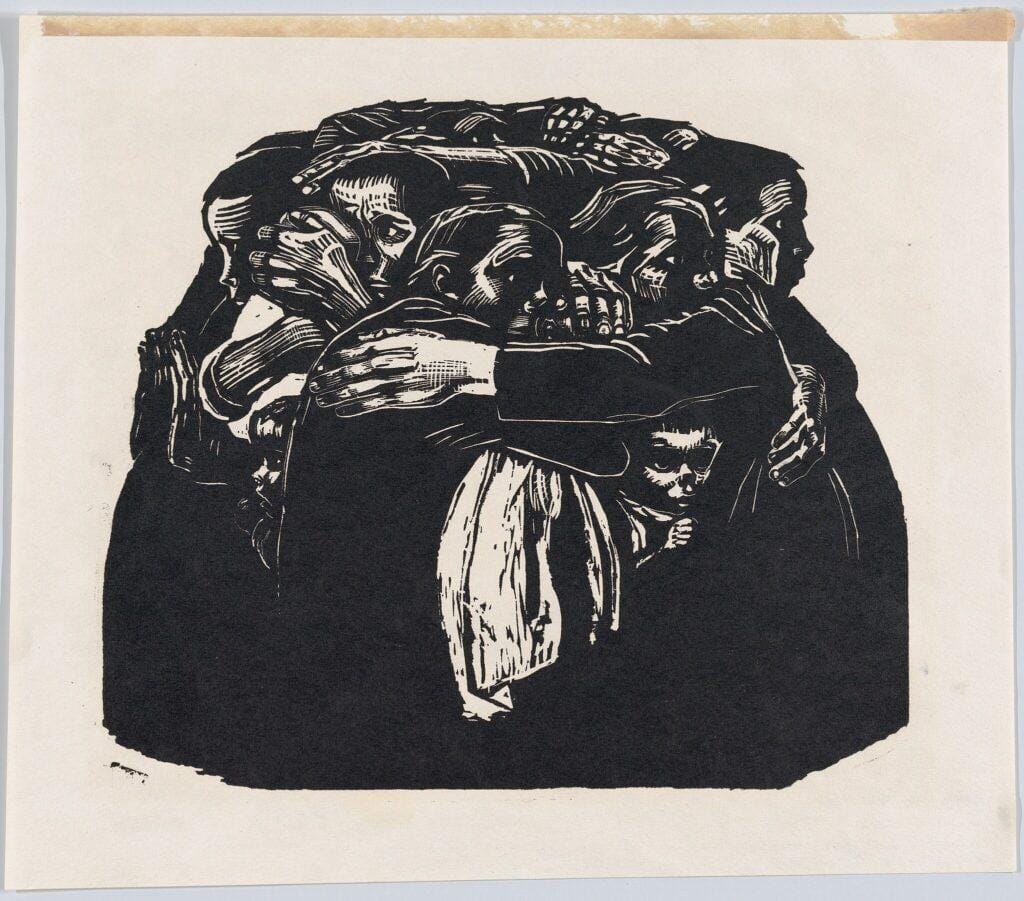
The people suffering most from this conflict are, of course, the people in Iran and elsewhere in the region experiencing devastating barrages of missiles and drones. This is highly industrialised warfare conducted at a distance, and the sense of terror is unimaginable for people like me. The first relatively industrialised war was probably a century ago with WWI. Beyond its obvious horrors and geopolitical implications, this inspired artists like Käthe Kollwitz. She lost her son Peter in its early months. That loss and her broader anti-war convictions shaped much of her work. The image below is called The Mothers (Die Mütter) and is from a series of woodcuts entitled War. Kollwitz depicted the suffering of women, children, and civilians during conflict, showing the impacts of war beyond the Frontlines. In this picture, a group of women huddle together in mourning. Horrifyingly, I am afraid we will continue to see many such groups in photographs and on our television screens in the months ahead.
Ultimately, periods of war are drawn to a close, however temporarily, when the leaders of military forces come together and negotiate some kind of settlement. This occasionally happens quickly but, more usually, it takes a long time to come to this point. One, or both, “sides” generally need to have fought themselves to a standstill and worn themselves out. In WWI, the armies were dug down in a trench warfare stalemate for many years. In the Iran-Iraq war of the 1980s, eight years were spent achieving little other than the death of over half a million people before the United Nations was able to broker a ceasefire between the exhausted participants. We are still in a war of attrition between Russia and Ukraine more than a decade after Russia’s annexation of Crimea and four years into the full-scale invasion of Ukraine.
What are the prospects for negotiation currently? The key participants are the US, Iranian and Israeli regimes. There are currently conflicting accounts of potential talks to end the war, with Iran describing reports of negotiations as “fake news”.
One challenge is that the most powerful military force in the world has been sent to war without a practically realisable victory objective. While seeking “regime change” in Iran may be an easy soundbite to use in the US, this is unlikely to happen without a powerful organised opposition supported by troops. For domestic political reasons, the Trump administration will not put visible “American feet on the ground” other than as a last resort, and so is desperately seeking another goal it can claim has been achieved so it can “declare victory”. This is a key element in the Trump regime’s deeply entrenched political playbook as inspired by Trump’s mentor Roy Cohn:
Attack, attack, attack
Admit nothing, Deny everything, Never apologise
Claim victory (even if you’ve lost).
I expect that the US regime wants to draw a line under the present conflict as soon as possible because domestic political support is waning, but the Iranian regime will make it as difficult as possible for them to claim a victory goal, and the Israelis will want to press on until there is, indeed, regime change in Iran that reduces the long-term threat to the country. Could the “feet on the ground” come from Israel? Possibly, but that would require confidence in long-term military support from the US that can no longer be guaranteed, particularly if there is a change in administration at the next US presidential election.
The obliteration of Iran’s capabilities to launch missiles or even continue its nuclear programme, will not, in itself, bring regime change even if there is increasing popular opposition in the country. The local military capabilities remain sufficient to suppress opposition, and the interests of current military leaders are stacked towards maintaining their grip on advantages from the existing regime. Hence, while individual leaders may be killed, the hardline regime will fairly certainly stay in place for the coming years. Economic and military capabilities will slowly be rebuilt, which can also be used directly or through proxies in sporadic attacks on targets outside Iran that help shore up domestic political legitimacy. So, even if this particularly dramatic episode is deemed to be “over” in the near future, regional instability will continue to rumble on.
So, various considerations point to another long drawn-out affair, even if the US finds a way to declare a victory and de-escalate its involvement. The timing before meaningful negotiation starts may be sooner or later, depending on the US’s willingness to continue action or supply armaments to Israel, the time it takes before both Iran and Israel have seriously depleted their missile and drone resources, and whether Israel is willing and able to deploy military support for a popular uprising and regime change in Iran.
In the meantime, the Russian war with Ukraine will be grinding on, and there remains the wildcard uncertainty of China and Taiwan. The way the “middle powers” in Europe, the Middle East and Asia play their roles over the coming years will have a huge influence on the way all these “major power” conflicts and tensions play out. This includes creating the space and circumstances for negotiation, and hence impacting the degree of misery that will ultimately be suffered by populations caught up in war.
As I have noted previously, “We are walking a tightrope, but a “might is right” world has no safety net”. Great wisdom, statesmanship, diplomacy, and socio-political maturity will be required from multiple parties to avoid the very worst scenarios and at least achieve less awful outcomes over the longer term. Question of The Fortnight
Every fortnight, I’ll be asking a thought-provoking question in hopes of sparking interesting and enlightening discussion.
I’d love to hear your response! You can do so by simply responding to this email.
Today’s question is:
Do you have a perspective on the current conflict in the Middle East? Do you believe in the possibility of an early resolution or do you see significant violence rumbling on for a long period ahead?
The Dodo Club Online Course
If you would like to learn more about the kinds of topics covered in these Newsletters, then please consider signing up for the introductory online course.
This covers scenario/systems thinking for grappling with uncertainty, an introduction to energy transitions, and the development of strategic character in leadership.
In the interest of avoiding the fate of that unfortunate bird, the Dodo, this course aims to help us secure our own personal legacies within a changing world and the energy transition - and to leave a healthier planet for future generations.
You can access the course through Udemy using the link below!
A series of follow-up courses that treat the main topics in increasing depth and detail will be provided if there is sufficient interest.